

Start with clinical fit, not just a screen. For online clinician guided treatment, look for a telehealth service where licensed clinicians assess your needs and guide care. You’ll need a computer, smartphone, or tablet with a camera and microphone, plus a reliable internet connection. The right treatment depends on your health needs and a clinician’s assessment, not simply on the convenience of a virtual appointment.
It’s reasonable to want clarity before beginning: what care includes, whether insurance may help, and how medication decisions are overseen. Online care can make access more convenient, but it still calls for a clear plan and appropriate clinical supervision.
This guide explains how online clinician-guided care works, how to compare treatment options, and what to consider about costs and medication safety. You’ll also learn how to assess whether a licensed clinician’s approach and the care format fit your goals.
Key Takeaways
- Prepare for a telehealth visit with a camera-enabled device, microphone, and reliable internet connection so you can focus on the clinical discussion.
- Understand that coverage for online care depends on your specific plan, while Medicaid coverage can vary by state.
- Prioritize licensed clinicians and collaborative medication management, including clear discussion of treatment goals and possible side effects.
- If you’re experiencing emotional distress or suicidal thoughts, call or text 988, the Suicide and Crisis Lifeline, according to the Substance Abuse and Mental Health Services Administration.
Insurance coverage and appointment policies
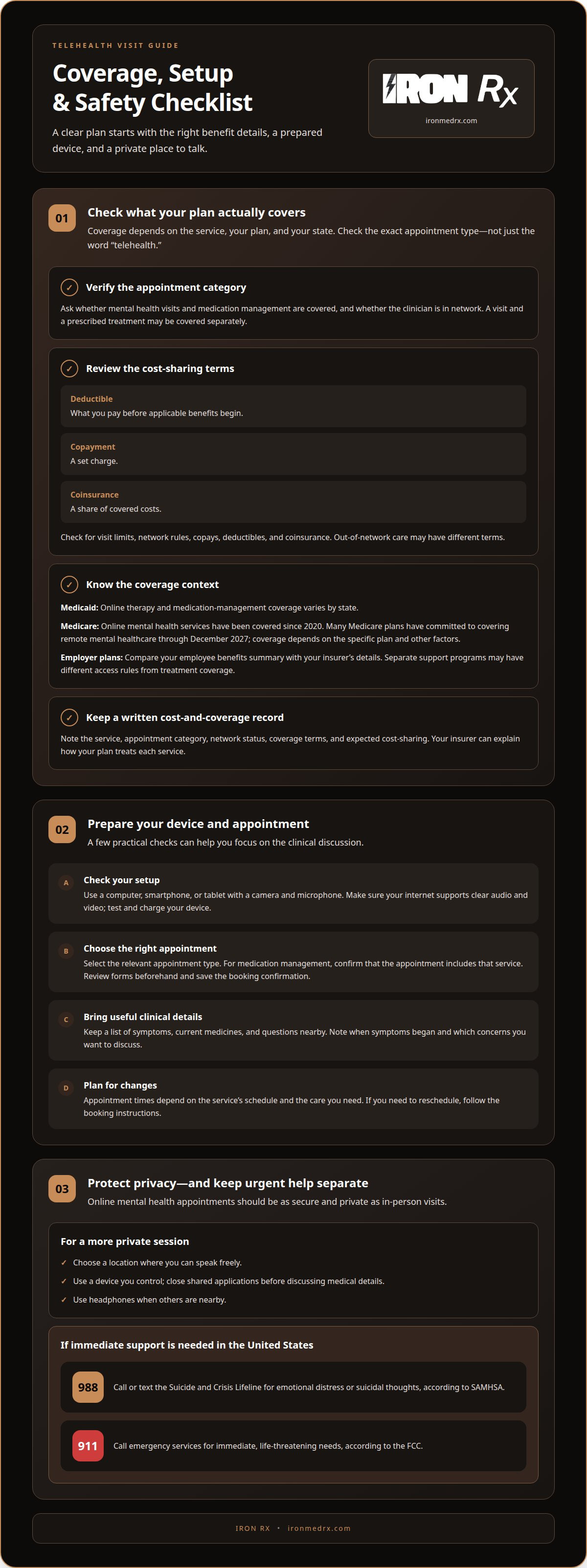
Insurance coverage for telehealth depends on the service, plan, and state. Medicaid coverage for online therapy and medication management varies by state because each state runs its own program. Medicare began covering online mental health services in 2020. Many Medicare plans have committed to covering remote mental healthcare through December 2027. Medicare may cover telehealth therapy and medication management, depending on the specific plan and other factors. Review your benefits for the exact appointment type, not telehealth alone. Ask whether mental health visits, medication management, copays, and deductibles apply. Your insurer can explain how your plan treats each service.
Prepare your technology before an appointment. Use a computer, smartphone, or tablet with a camera and microphone, and check that your internet connection supports clear audio and video. Test and charge your device, then choose a private room. Keep a list of symptoms, current medicines, and questions nearby. Note when symptoms began and which concerns you want to discuss, so you can use the appointment time for clinical questions.
Appointment times depend on the service’s schedule and the type of care you need. During booking, choose the relevant appointment type, provide the requested details, and save the confirmation. For medication management, select an appointment that includes that service. Review any forms beforehand and have relevant health details ready. If you need to reschedule, follow the booking instructions. Preparing in advance can help you describe your symptoms and questions clearly.
Privacy and urgency require separate plans. Online mental health appointments should be as secure and private as in-person visits. Choose a location where you can speak freely, and use a device you control. For emotional distress or suicidal thoughts in the United States, call or text 988 for the Suicide and Crisis Lifeline, according to the Substance Abuse and Mental Health Services Administration. For immediate, life-threatening needs, call 911 for emergency services, according to the Federal Communications Commission.
Insurance coverage and out-of-pocket costs
Costs depend on the service and your health plan. Consider the clinical visit separately from medication or other treatment expenses.
Telehealth Insurance Coverage
Telehealth coverage can differ for mental health visits, medication management, and other clinical services. Review your plan’s benefit summary for covered appointment types, network rules, deductibles, copayments, and coinsurance. A clinician’s visit and a prescribed treatment may be handled separately, so coverage for one does not necessarily include the other. Check for any limits on visit types or treatment pathways.
Estimate your costs using your plan’s cost-sharing terms. A deductible is what you pay before applicable benefits begin; a copayment is a set charge, while coinsurance is a share of covered costs. Out-of-network care may have different terms from in-network visits. Note the appointment category, network status, and relevant cost-sharing rules in your plan documents. This makes comparisons more useful than relying on a general “telehealth” label.
Insurance and Employer Coverage
Employer-sponsored insurance follows the benefits selected for that plan. Review your employee benefits summary alongside your insurer’s coverage details, comparing mental health visits, medication management, network requirements, and cost-sharing. If workplace materials describe a separate support program, distinguish its access rules from the health plan’s treatment coverage. This helps clarify which visits count toward plan benefits and what costs remain yours.
Before scheduling, identify the service you need and match it to the plan’s benefit category. Keep a written record of coverage terms, network status, and expected cost-sharing for each type of visit. For a broader view of clinician-guided care options, consider how clinical oversight fits your treatment goals as well as your coverage.
Is telehealth medication management safe?
Telehealth can support medication decisions when assessment, prescribing, and follow-up are clinically guided. Safe online clinician guided treatment depends on clear communication, sound clinical judgment, and follow-up that responds to changes in your health. Remote care also has limits, so consider whether a clinician can assess your needs effectively online.
Medication Safety and Prescribing
A medication plan should reflect symptoms, health history, and treatment response, not a quick prescription. Finding an effective psychiatric medicine with the fewest side effects may take several tries, so share prior responses and current medicines with the provider. Psychiatrists and other mental health professionals can use follow-up sessions to review benefits and concerns. Pandemic-era rules allowing mental health practitioners to prescribe controlled substances online without an in-person exam are set to expire in December 2026.
Online Prescriptions and Delivery
A prescription is a clinical decision, not an automatic outcome of an online visit. A clinician considers your symptoms, relevant medical history, and whether a treatment suits your care plan. If prescribed, the medication and pharmacy determine how it is processed and delivered. Keep medication details and instructions together, and raise side effects or changes in your symptoms during follow-up.
Privacy and Security Rules
In the United States, online mental health appointments should be as secure and private as in-person visits. Protect your session by using a private room, a device you control, and headphones when others are nearby. Close shared applications before discussing medical details. Online therapy regulations can vary greatly by state, so the patient’s location can affect applicable practice requirements.
Treatment Risks and Care Limitations
Online clinician-guided treatment has limits: a video session may not provide the physical examination or immediate support a situation requires. Online clinician guided treatment may be unsuitable when symptoms call for hands-on assessment or urgent attention. Seek in-person medical care when physical evaluation is needed. For an immediate, life-threatening emergency in the United States, call 911 for emergency services, according to the Federal Communications Commission.
Choosing a clinician and treatment type
Choose care that matches your concerns to a licensed clinician’s scope and a format you can use consistently. The right choice depends on your assessment, treatment goals, and whether remote sessions meet your needs.
Types of Online Clinicians
Psychiatrists and therapists may provide mental health care online, but confirm that your treating provider is a licensed clinician. Life coaches are not licensed or regulated in the same way as mental health clinicians, so coaching is not a substitute for formal treatment. Online care may address concerns such as stress or symptoms of depression when remote assessment is appropriate. Review the clinician’s credentials and focus before booking.
Online and In-Person Care
Online mental health treatment can be just as effective as in-person visits. Virtual appointments may fit around work or caregiving, while in-person care allows direct physical assessment. Consider privacy, comfort speaking on camera, and whether your concerns may require an examination. For online clinician guided treatment, choose a format that supports open discussion and consistent follow-up, rather than convenience alone.
Assessment Through Follow-Up
Start by describing your symptoms, health history, current medicines, and treatment goals during the initial assessment. After the first meeting or two, an online mental health clinician should share a diagnosis and treatment plan. The plan can identify recommended session frequency and how many visits may be part of care. Review consent documents before they’re signed, and raise questions about options. This structure helps make online clinician guided treatment a collaborative process, from initial assessment through follow-up.
For anxiety, depression, or other mental health concerns, care may include therapy, medication management, or both, depending on clinical assessment. Discuss how progress will be reviewed and what changes should prompt another appointment. For a separate, clinician-guided approach to personal health goals, explore clinician-guided care options.
IRON RX: Tirzepatide Injections
IRON RX offers Tirzepatide Injections as a clinician-guided option for people considering weight management treatment. The care plan is personalized around your goals and clinical assessment. Tirzepatide Injections are distinct from GHK-Cu Skin Cream, so the appropriate option depends on your goals and a clinician’s evaluation.
Use an initial online evaluation to discuss your goals, health history, and treatment questions with a licensed medical professional. Prescription products require this evaluation; no in-person clinic visit is needed. A clinician-guided plan can help you understand whether an option fits your needs and how care will be managed. Compare treatments by their purpose and clinical oversight, rather than assuming one option suits everyone.
To discuss whether Tirzepatide Injections fit your goals, contact IRON RX.
Choose a Next Step That Fits Your Goals
Turn broad health priorities into a focused conversation about what matters to you. An online clinician guided treatment plan should consider your goals, relevant health details, and treatment options. This gives you a clearer basis for deciding what fits.
IRON RX offers Tirzepatide Injections, Copper peptide cream, and NAD+ Injection - 1000 mg. As you consider online clinician guided treatment, focus on which offering aligns with your goals and a clinician’s assessment, rather than assuming one option suits everyone.
Bring your priorities and questions to the conversation. If online clinician guided treatment fits the direction you’re considering, contact IRON RX to discuss your options and take a thoughtful next step.
Frequently Asked Questions
How can you reach a doctor?
Choose a telehealth appointment with a licensed clinician whose practice covers your concern. Review the clinician’s credentials and the appointment type, then complete the intake questions and select an available time. For example, a patient seeking medication guidance should choose a visit that includes medication management, rather than assuming a general wellness appointment covers prescribing. Have your current medication list ready.
How long are visits?
Visit length varies with the appointment’s purpose and the discussion required. An initial assessment may involve reviewing your history, symptoms, and goals, while a follow-up may focus on treatment response or medication questions. Read the appointment details before booking and reserve enough private time to speak without interruption. Bring focused questions so the conversation can address your priorities.
How soon can I schedule a virtual visit?
Scheduling depends on the open appointment times shown by the service you choose. Review those options, select a time that suits your needs, and complete any intake steps promptly to keep the booking process moving. If the available schedule doesn’t fit, revisit it later for newly posted openings. Appointment availability is not a fixed national timeline.
What is online clinician-guided treatment?
Online clinician-guided treatment is care delivered remotely with a licensed medical professional involved in assessing your needs and directing a treatment plan. Depending on the concern, that care may include therapy, medication management, or both. It differs from self-directed wellness content because a clinician evaluates the patient’s situation and can guide follow-up decisions as care progresses.
How much does online clinician-guided treatment cost in the United States?
Costs depend on the appointment, treatment, and insurance arrangements. Consider the clinician’s charge separately from medication or other treatment expenses, and account for deductibles, copayments, coinsurance, and network status. Comparing the expected total out-of-pocket cost for the care you need gives a more useful picture than looking at an appointment fee alone.
Does health insurance cover online clinician-guided treatment?
Coverage depends on your plan and the specific service, so mental health visits and medication management may be treated differently. IRON RX does not accept insurance, though out-of-network reimbursement may be possible. Review your plan’s telehealth benefits and reimbursement rules to understand how they apply and which expenses may remain your responsibility.


