
The route matters as much as the molecule. NAD+ injections bypass digestion, but the injection method affects how NAD+ enters the body. If you’re considering nad injections, understanding this distinction is a useful first step.
It’s reasonable to wonder whether an injection delivers NAD+ more reliably than an oral supplement. But absorption alone doesn’t establish a particular benefit. This guide explains how delivery methods differ and what the evidence can and can’t tell you.
You’ll also learn what to consider about safety, medications, cancer history, prescriptions, and FDA status. The goal is to clarify the biology and medical context so you can weigh treatment with informed expectations.
Key Takeaways
- Understand NAD+’s role in cellular energy and why that biology alone doesn’t establish the benefits of injections.
- Review how your medications, supplements, and cancer history affect whether NAD+ therapy is an appropriate topic for a clinician discussion.
- Distinguish a compounded medication and a registered compounding facility from an FDA-approved drug.
- Compare injection routes: tissue and blood supply influence how quickly NAD+ enters circulation.
Do NAD+ injections interact with any medications or supplements?
NAD+ is a coenzyme found in every cell, where it helps convert nutrients into usable energy. NAD+ and NADH work together in cellular metabolism: NAD+ accepts electrons during chemical reactions, and NADH carries them toward energy production. This process supports everyday cell functions. That role helps explain interest in NAD+ injections, but it doesn’t establish their clinical effects.
NAD+ also supports DNA repair, cell survival, and normal function in tissues such as muscle and brain. The body makes it from precursors, including vitamin B3 forms and tryptophan. NAD+ levels naturally decline with age, but this biological change alone doesn’t show that injections restore youthful function or prevent disease.
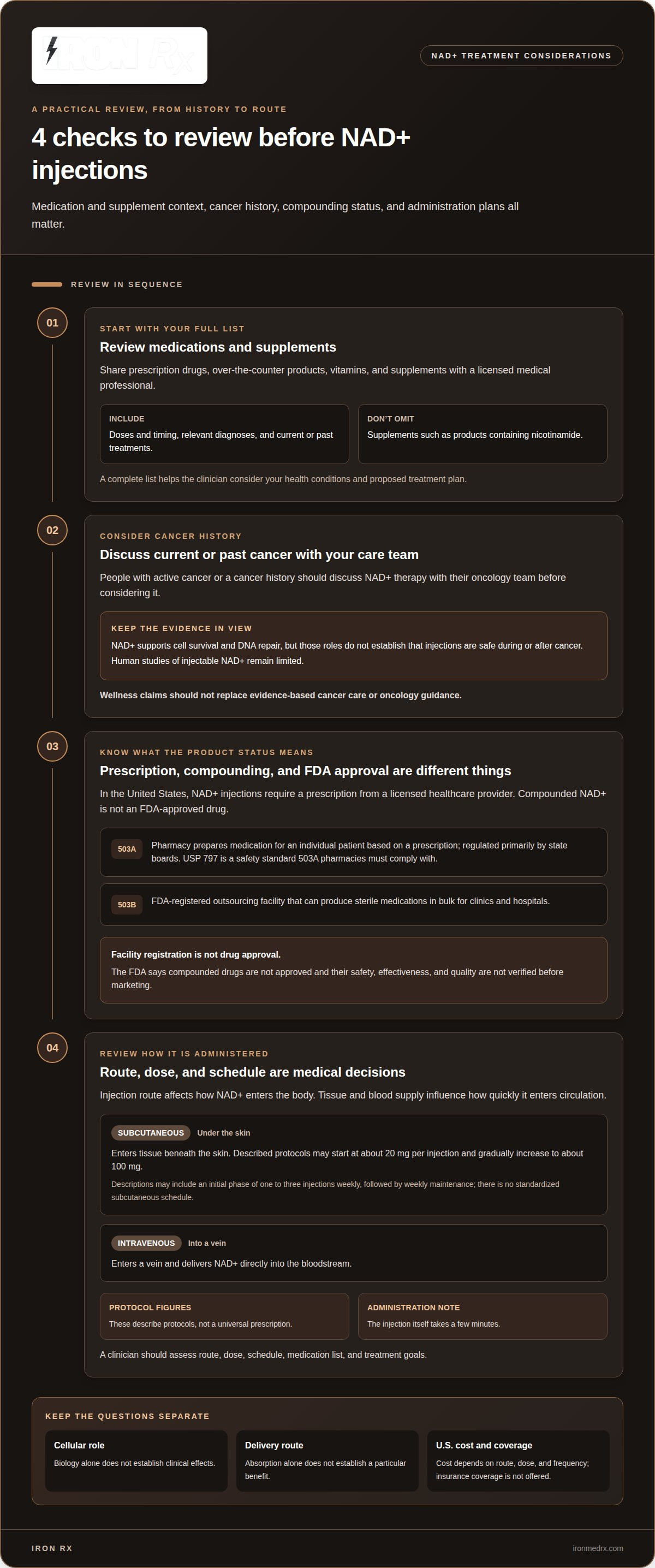
Before treatment, review your complete medication and supplement list with a licensed medical professional. Include prescription drugs, over-the-counter products, vitamins, and supplements, along with doses and timing. This helps the clinician consider your health conditions and proposed treatment plan. It’s a practical safeguard when weighing NAD+ injections alongside other products.
In the United States, cost depends on route, dose, and frequency, and is provided after a quote request. Insurance coverage isn’t offered for this treatment.
Administration depends on the route: subcutaneous injections enter tissue beneath the skin, while intravenous delivery enters a vein. Subcutaneous protocols don’t have a standardized schedule; descriptions may include an initial phase of one to three injections weekly, followed by weekly maintenance. The injection itself takes a few minutes.
Subcutaneous dosing is described as starting at about 20 mg per injection and gradually increasing to about 100 mg. These figures describe protocols, not a universal prescription. Route, dose, and schedule are medical decisions, so a clinician’s assessment should account for your medication list and treatment goals.
Cancer-related cautions and contraindications
Cancer history is an important safety consideration before NAD+ treatment. Discuss any current or past cancer with a clinician before considering it.
Cancer-Related Cautions
People with active cancer or a cancer history should discuss NAD+ therapy with their oncology team before considering it. NAD+ supports cell survival and DNA repair, but those roles don’t establish that injections prevent damage or are safe during or after cancer. Human studies of injectable NAD+ remain limited, so wellness claims should never replace evidence-based cancer care or oncology guidance.
Contraindications and Precautions
A contraindication is a condition or circumstance that makes a treatment inadvisable; a precaution signals the need for careful review. Cancer history is one specific concern, and your medication and supplement list is another important part of a full assessment. Share relevant diagnoses, past treatments, and current supplements, including products containing nicotinamide, so the clinician can consider the whole picture, not NAD+ levels alone.
Before treatment, ask: “Does my current or past cancer history make NAD+ therapy inappropriate?” and “How might my medication and supplement list affect the safety assessment?” These questions focus the conversation on your history, treatment context, and the evidence behind the proposed plan.
Product quality also matters for injections. In the United States, 503A compounding pharmacies prepare medications for individual patients based on prescriptions, while 503B outsourcing facilities can produce sterile medications in bulk. USP 797 is identified as a safety standard for 503A pharmacies. Consumers are advised to verify that injections come from FDA-registered 503B facilities or, at minimum, 503A pharmacies with validated sterile production processes. FDA registration does not mean a compounded drug is FDA-approved; the FDA says compounded drugs aren’t approved and their safety, effectiveness, and quality aren’t verified before marketing.
For a considered decision, weigh cancer history, other diagnoses, product sterility, and the limits of current evidence together.
Do I need a prescription for NAD+ Injection and is it FDA-approved?
In the United States, NAD+ injections require a prescription from a licensed healthcare provider. They aren’t FDA-approved for a specific medical condition or cosmetic skin rejuvenation. Compounded NAD+ is a prescription preparation, not an FDA-approved drug. A prescription allows individualized compounding; it doesn’t establish FDA approval or prove the treatment is effective for a particular goal.
The U.S. Food and Drug Administration says compounded drugs aren’t FDA-approved and does not verify their safety, effectiveness, or quality before marketing. FDA registration of a compounding facility is not FDA approval of the medication it prepares. When evaluating claims about NAD+ injections, remember that facility registration and drug approval are separate things.
Compounding follows two pathways. A 503A pharmacy prepares medication for an individual patient based on a prescription and is regulated primarily by state boards. A 503B outsourcing facility is FDA-registered and can produce sterile medications in bulk for clinics and hospitals. USP 797 is a safety standard that 503A pharmacies must comply with.
Compounded NAD+ is described as a freeze-dried powder supplied in 500 mg amounts. That format differs from oral supplements containing NAD+ precursors, such as nicotinamide riboside or nicotinamide mononucleotide. The body converts those precursors into NAD+, while an injection bypasses digestion. Intravenous therapy delivers NAD+ directly into the bloodstream; subcutaneous administration enters tissue under the skin.
To find a reputable provider near you, look for care involving a licensed prescriber and a prescription, alongside transparent information about the compounding pathway. For product sourcing, the stated criteria are an FDA-registered 503B facility or, at minimum, a 503A pharmacy with validated sterile production processes.
Ask which compounding pathway supplies the medication and what evidence supports the proposed clinical use. These questions can help you evaluate NAD+ injections without confusing a supplement, a compounded preparation, and an FDA-approved treatment.
NAD+ injection absorption and bioavailability
The route shapes how NAD+ enters circulation, but absorption isn’t the same as a proven cellular benefit. Intravenous delivery places NAD+ directly into the bloodstream, bypassing digestive and tissue absorption barriers. Subcutaneous injection places it under the skin, where absorption is slower and steadier because the tissue has fewer blood vessels than muscle.
Intramuscular injections are absorbed faster than subcutaneous injections because muscle has a richer blood supply. Bioavailability comparisons across delivery routes can be difficult to interpret and do not by themselves establish cellular effects. These comparisons describe how a substance reaches circulation; they don’t establish how much reaches mitochondria or changes cellular function.
A human pilot study administered 750 mg of NAD+ intravenously over six hours, at about 2 mg per minute. Another study examined changes in plasma and urine NAD+ during a six-hour infusion. These studies help illustrate how researchers measure circulating NAD+ and its metabolites, not whether a particular protocol improves energy production or health outcomes.
Oral precursors take a different path: the body converts compounds such as nicotinamide riboside or nicotinamide mononucleotide into NAD+. Foods provide nutrients used to make NAD+, rather than meaningful amounts of NAD+ itself. Naturally occurring metabolism also relies on linked chemical reactions that transfer electrons and help cells produce energy.
The practical takeaway is to distinguish delivery from effect. IV administration offers direct bloodstream exposure; subcutaneous delivery is steadier, while intramuscular absorption is faster. Route, dose, and protocol describe treatment logistics, not proof that NAD+ levels rise in specific tissues or that aging-related changes reverse. Stress, sleep, and physical activity also influence overall health, so an injection shouldn’t replace these foundations.
For a closer look at a clinician-guided approach, explore NAD+ care options.
IRON RX: Tirzepatide Injections
IRON RX offers Tirzepatide Injections for people exploring a clinician-guided approach to weight management. If your main goal is weight management rather than investigating NAD+ absorption, this may be a more relevant treatment to discuss with the care team.
For readers focused on NAD+ therapy, IRON RX also offers NAD+ Injection - 1000 mg. A personalized plan can help put an option in context with your goals and health considerations, without treating a mechanism or an injection route as proof of a particular outcome.
To explore which IRON RX offering aligns with your goals, contact the care team.
Choose your next step with clarity
The decision isn’t simply whether to pursue NAD+ injections. Consider whether the treatment fits your health history, priorities, and expectations for care. Bring those priorities into a conversation with a licensed healthcare provider, including any cancer history, medications, and supplements that could shape the discussion.
IRON RX offers NAD+ Injection - 1000 mg, Tirzepatide Injections, and Copper peptide cream. These options serve different goals, so the most useful next step is to identify what you want support with and explore the relevant offering without assuming one treatment fits every need.
If you have questions or want to discuss which option aligns with your goals, contact IRON RX. A deliberate conversation can help you move forward with greater clarity and confidence.
Frequently Asked Questions
How does it work?
NAD+ participates in chemical reactions that transfer electrons as cells process nutrients. In practical terms, the injection route determines how the substance enters circulation, not whether a particular health outcome follows. Intravenous delivery enters the bloodstream directly, while subcutaneous delivery passes through tissue first. This distinction helps explain exposure, but it doesn’t establish how a person will feel.
What are the benefits of NAD+ injections?
Potential benefits remain uncertain because human research on NAD+ injections is limited. NAD+ has roles in cellular processes, but that biology alone doesn’t demonstrate that treatment improves energy, focus, or another symptom. If you’re considering NAD+ injections for a specific concern, define the outcome you hope to change and discuss how to assess it with a licensed healthcare provider.
Are NAD+ Anti-Aging Injections Really Worth the Hype?
Claims of anti-aging effects go beyond what current clinical evidence establishes. Most research on NAD+ and aging examines oral precursors or laboratory models, rather than injectable NAD+. That makes broad promises about reversing aging difficult to assess. Consider whether the proposed goal has been studied in people receiving injections, and distinguish plausible biological mechanisms from demonstrated outcomes.
Are NAD+ injections safe?
Safety depends on the preparation, route, and your health context. During an IV infusion, reported effects can include nausea, flushing, and chest or abdominal discomfort. Discuss your health history and current products with a licensed clinician, including what symptoms would prompt you to stop treatment and seek medical advice. Sterile preparation is also essential for injection safety.
But does injecting NAD+ improve the skin?
Large clinical trials haven’t established that NAD+ injections reduce wrinkles, improve firmness, or rejuvenate skin. NAD+ depletion in skin has been linked with weaker barrier function, reduced collagen production, and increased inflammation, but those associations don’t prove injections reverse these changes. For a cosmetic goal, distinguish skin findings from research on other routes or laboratory models.
Can NAD+ injections be used during pregnancy or breastfeeding?
Pregnancy and breastfeeding call for a specific review of medications and supplements with an obstetric clinician before starting an injectable treatment. Bring the product details and your complete medication list to that conversation. Discuss why you’re considering NAD+, the available human evidence, and whether treatment should be postponed. General wellness claims don’t establish suitability during pregnancy or lactation.


