

Online testosterone care should begin with clinical evaluation, not a prescription based on symptoms alone. A total testosterone level of 300 ng/dL or less is commonly used to define low testosterone, and men's TRT treatment online should pair blood testing with a clinician’s review of symptoms and relevant health factors. FSA or HSA payment is account-specific, so it’s worth understanding how your plan handles the expense before making treatment decisions.
Low energy, reduced sex drive, mood changes, and loss of strength can have causes beyond low testosterone. Testing helps put symptoms in context and informs whether treatment may be appropriate. This guide explains what testosterone testing can show, how results are interpreted, what treatment may involve, and how clinician-guided online care works. You’ll also learn what to consider when assessing FSA or HSA payments, monitoring, and potential benefits and risks of TRT, so you can approach your next step with clearer expectations.
Key Takeaways
- Learn how testosterone test results are interpreted, including why a single number needs clinical context.
- Understand what to consider about treatment formulations and how compounded testosterone differs from FDA-approved medications.
- Recognize symptoms that may warrant evaluation and why they can have causes other than low testosterone.
- See how physician-guided telehealth care can shape testing and treatment decisions, and what to consider when using FSA or HSA funds.
Testosterone blood testing and reference range
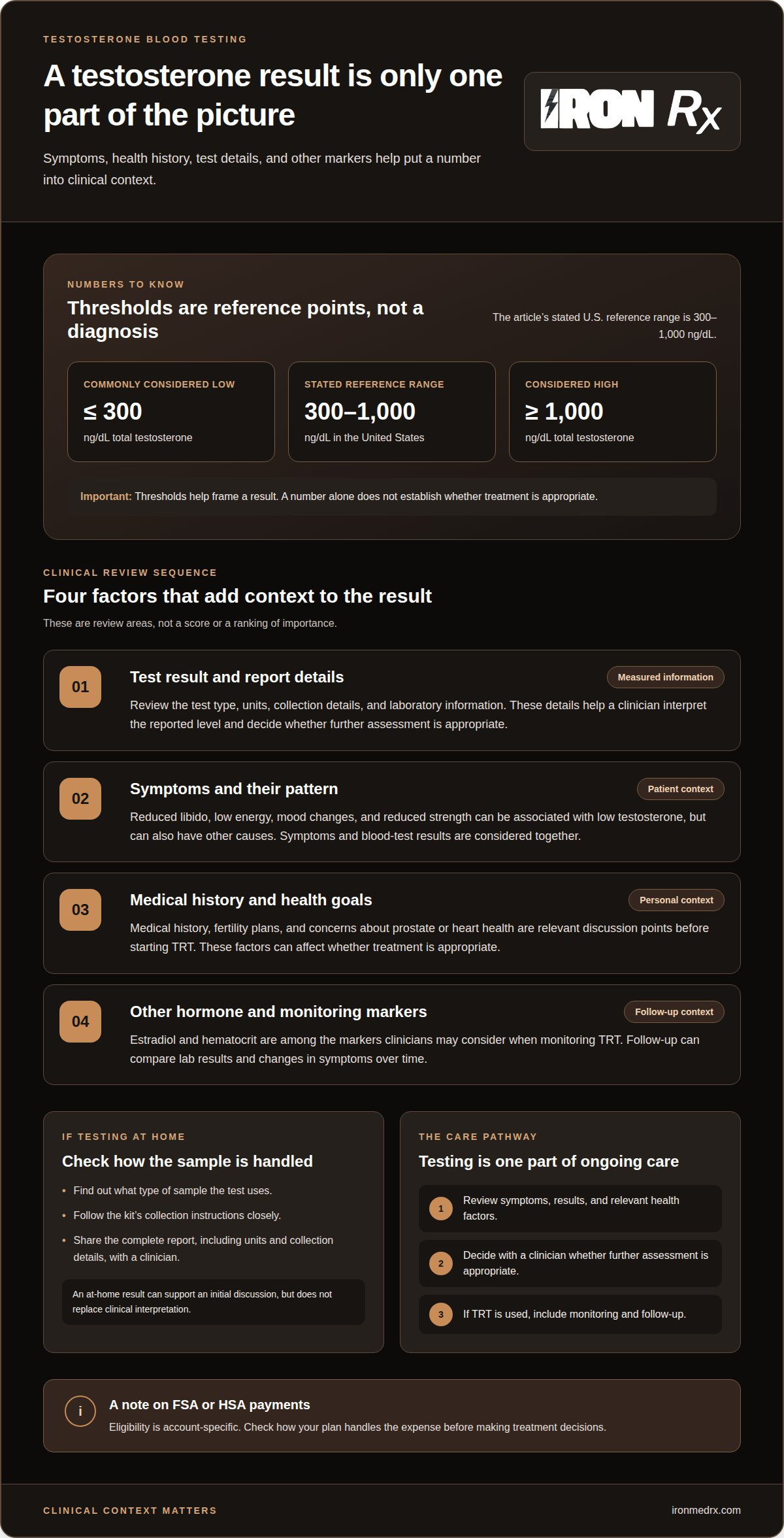
Testosterone testing turns symptoms into measurable information, but lab results need clinical context. In the United States, the stated reference range is 300 to 1,000 nanograms per deciliter.
A total testosterone level of 300 ng/dL or less is considered low, while a level of at least 1,000 ng/dL is considered high. These thresholds help frame results, but a number alone does not establish whether treatment is appropriate. Symptoms, medical history, and other hormone biomarkers also shape interpretation.
Testosterone testing usually begins with a blood sample and a report of the measured levels. Review the test type, units, collection details, and laboratory information. These details help a clinician interpret results and decide whether further assessment is appropriate.
Biomarker Assessment and Monitoring
Testosterone is one part of a broader hormone assessment. Estradiol and hematocrit are among the markers clinicians may consider when monitoring TRT, alongside other relevant results. A clinician can interpret these measures in light of symptoms and medical history, then use follow-up to assess your response. A personalized review is more informative than relying on testosterone alone.
For men's TRT treatment online, monitoring should be part of care, not a one-time review before treatment. Keep each lab result available for comparison at follow-up. Changes in symptoms, testosterone, estradiol, or hematocrit can help inform subsequent clinical decisions.
At-Home Testosterone Testing
At-home testosterone testing offers a way to collect a sample outside a clinic. Before relying on a result, find out what type of sample the test uses, how to collect it, and whether a laboratory analyzes it. Follow the kit instructions closely, as collection errors can affect how useful the result is.
An at-home result can support an initial discussion, but it does not replace clinical interpretation. Share the complete report, including units and collection details, so a clinician can assess whether further lab testing is appropriate.
If you have concerns about fertility, prostate health, or heart health, discuss them with a clinician before starting TRT. These factors can affect whether treatment is appropriate and should be part of the decision.
Online TRT medication options and formulations
Medication choice depends on clinical assessment, treatment goals, fertility plans, and the monitoring required for each option. A prescription follows an evaluation, not a symptom checklist alone.
Online care and care with a primary care doctor or urologist can both include a review of symptoms, medical history, and lab results. Telehealth provides that discussion remotely, while an in-person clinician can assess you directly. Either approach should address relevant health concerns and follow-up.
Medication Formats and Options
Clinicians may discuss testosterone formulations such as injections or topical preparations. The choice can depend on medical history, preferences, and the monitoring plan. Ask what medication is proposed, how to use it, and what follow-up will support your care.
Fertility plans matter. If you have fertility concerns, discuss them before starting testosterone and ask whether enclomiphene is being considered as an alternative or part of a different approach. Supplements, changes in weight, libido concerns, and other medicines are also useful topics for your clinical discussion.
Understand the billing structure before proceeding. Clarify whether a membership covers clinician access and ongoing care, or whether medication, lab testing, and follow-up are handled separately. This helps you understand what each part of the program includes, rather than treating a medication label as the entire service.
The U.S. Food and Drug Administration states that compounded testosterone is not FDA-approved and that it does not verify compounded products’ safety, effectiveness, or quality before marketing. Ask whether a proposed medication is FDA-approved or compounded, and discuss what that distinction means for your care.
Pharmacy Access and Medication Delivery
Before treatment begins, understand how a prescription reaches a pharmacy and how the medication is supplied. Discuss the pharmacy’s role, the product dispensed, and the refill process with the prescribing service. These steps connect the clinical plan to the medication you receive.
Ongoing care should include a clear way to review changes, discuss concerns, and coordinate lab testing. For online treatment, understand how follow-up works if your medication or symptoms change. Delivery is one part of care, not the end of it.
Potential symptoms and effects of low testosterone
Symptoms can include reduced libido, low energy, mood changes, and reduced strength. These experiences can also have causes unrelated to testosterone, so symptoms alone do not establish a diagnosis or justify testosterone replacement therapy. A clinician considers the pattern alongside your health history and lab results.
Low testosterone is assessed by considering symptoms and blood-test results together. Before TRT, evaluation should include relevant lab testing and a review of medical history, fertility goals, and health concerns. This helps distinguish clinically low testosterone from symptoms that may have another explanation.
Testosterone replacement therapy directly supplies testosterone. Injectable and transdermal formulations are options to discuss with a licensed clinician, who considers the patient’s health history and monitoring needs. One study followed 105 men aged 40-74 using intramuscular testosterone cypionate for 18 months at 200 mg every two weeks. That study regimen is not an individual treatment recommendation.
FDA-approved and compounded testosterone are different categories. According to the U.S. Food and Drug Administration, compounded testosterone is not FDA-approved, and the FDA does not verify its safety, effectiveness, or quality before marketing. Ask which type a proposed therapy uses and what that means for an informed treatment decision.
Discuss potential risks and side effects before therapy begins. Testosterone can affect fertility, so raise this concern before considering treatment if you plan to have children. Ongoing assessment may include hematocrit and estradiol, alongside symptoms and other relevant markers, to identify changes that need clinical attention.
Injectable and transdermal options differ in how medication is administered and incorporated into daily care. Discuss your practical preferences, follow-up, and monitoring with a clinician. For online men's TRT treatment, remote access should not replace a thorough evaluation or a plan to review your response and any emerging concerns.
Telehealth physician consultation and personalized treatment plans
An effective telehealth consultation is a clinical conversation, not a checkout step. The clinician needs to understand why you’re seeking care, how it affects your daily life, and what you want clarified. Share concise context so the discussion can focus on decisions rather than assumptions.
Use the appointment to explain your priorities, not simply request a prescription. Describe desired outcomes in practical terms, such as maintaining work routines or training consistently. Ask the clinician which findings support treatment, call for further evaluation, or point toward another approach.
A personalized treatment plan should turn the assessment into a clear sequence. It can explain the clinical rationale, the approach if treatment is prescribed, instructions for use, follow-up arrangements, and when to contact the care team. Understanding how these elements fit together helps distinguish a considered plan from a medication recommendation without ongoing medical oversight.
Before ending the consultation, clarify practical responsibilities: how prescriptions are issued, how refills are handled, and how to share new information. Ask how the care team records your baseline and reviews progress at follow-up. A written plan gives you a reference when questions arise or your routine changes.
Monitoring creates a feedback loop. At follow-up, the clinician considers your experience alongside updated clinical information and documents whether the current approach remains appropriate. Report side effects promptly, and don’t change prescribed treatment on your own. Clear notes about changes since your last review help the clinician assess what may relate to treatment and what needs separate attention.
Telehealth works best when expectations are clear: you share accurate updates, and the clinician explains the reasoning and next steps. To understand how this model supports individualized care, explore physician-guided TRT care as part of the clinical evaluation process.
IRON RX
IRON RX provides clinician-guided care for men considering their next steps in health. If you’re weighing hormone treatment, start with a personalized clinical discussion that considers your symptoms, test results, health history, and goals. Treatment decisions depend on that evaluation, and a prescription is not automatic.
The care team can help you understand how your information informs a plan and what follow-up may involve. This is useful if you want professional guidance to make sense of testing and treatment considerations before deciding what to do next.
For a thoughtful discussion about your care, contact IRON RX.
Choose a Clear Next Step for Your Health
A considered health decision should fit the life you want to sustain, not just the outcome you hope to reach. Deciding about men's TRT treatment online can be an opportunity to define what feeling better means in practical terms, such as maintaining daily routines or feeling more confident in your health choices. Keep your priorities in view as you weigh the options, and allow yourself time to make an informed decision rather than treating speed as a measure of success.
Use that perspective to guide your next conversation: focus on the questions that matter to you and the kind of support that would help you stay engaged with your care. IRON RX offers a clinician-guided setting to continue that consideration. Explore IRON RX’s approach to hormone care and decide whether it aligns with the way you want to move forward. Your health decisions can be deliberate, personal, and grounded in your goals.
Frequently Asked Questions
Can I pay with an FSA or HSA?
Whether you can use an FSA or HSA depends on your account’s eligibility rules and payment process. Review your plan documents for requirements about eligible expenses, receipts, and supporting records. Keep itemized documentation for any payment you submit. FSA and HSA rules can differ, so check how your account handles the specific expense before relying on those funds.
How do you find TRT online?
Start with the online intake process and follow the steps for identity verification and clinical evaluation. At IRON RX, prescription products require an online evaluation with a licensed medical professional; no in-person clinic visit is needed. Provide accurate information and review how the service communicates next steps. An online search or completed form alone does not provide a prescription.
How will I know if I’m eligible for medication?
Eligibility is determined through clinical evaluation, not by completing an intake or choosing a medication yourself. The clinician decides whether prescribing is appropriate after reviewing the information needed to make that decision. If questions remain, further assessment may be part of the process. A prescription is issued only when the clinician determines it is appropriate.
If eligible, how much does testosterone treatment cost?
The total expense depends on the prescribed treatment and what the care arrangement includes. Consider medication, clinical care, laboratory services, and follow-up as separate parts of the overall expense. Before starting, review the charges and billing terms presented for your care so you understand what is included and what is billed separately. Do not assume treatment costs based on medication format alone.
Is insurance required?
No. IRON RX does not accept insurance for treatment. Out-of-network reimbursement may be possible, depending on your insurance plan and its requirements. Review your plan’s claim process and documentation rules before submitting an expense. Insurance reimbursement and FSA or HSA eligibility are separate questions, so consider them independently.
What symptoms and lab results qualify men for testosterone replacement therapy (TRT)?
No single symptom automatically qualifies someone for TRT. The article’s stated reference point is a total testosterone level of 300 ng/dL or less, considered alongside relevant symptoms and clinical assessment. A result at that threshold is not, by itself, an automatic prescription. Describe how concerns affect daily life and bring the complete laboratory report to the evaluation.
The above statements have not been evaluated by the Food and Drug Administration. These products are not intended to diagnose, treat, cure, or prevent any disease.


